
Key Points
- The Trump administration and the SEC say they want to eliminate the need for quarterly financial reports by public companies, a move that would reduce the regulatory burden on companies and encourage more long-term thinking.
- But a number of factors could cause companies to continue to report more often than semiannually, including shareholder demands, the prospect of activist pressure and the possibility that less frequent reporting would result in less analyst coverage.
- Changing to semiannual reporting could also complicate capital raising, share buybacks and trading windows for insiders.
__________
Public companies in the U.S. could soon be freed of the obligation to report financial information every quarter.
The Securities and Exchange Commission (SEC) has indicated it will support shifting to a semiannual reporting following President Donald Trump’s renewed call to end mandatory quarterly reporting. But many companies could decide to disclose financial information more frequently for a variety of reasons, including pressure from investors, analysts and activists, and because of potential complications for trading and fair disclosures.
Altering the reporting requirements would require the SEC to go through its rulemaking process, first proposing rules, then subjecting them to a public comment period before finally adopting them. But SEC Chairman Paul Atkins stated that the SEC is fast-tracking President Trump’s proposal.
Potential Implications
Semiannual reporting would have various potential implications for public companies, positive and negative:
Long-term focus. The shift to semiannual reporting could potentially allow management to focus more on long-term investments and business strategy rather than quarterly earnings. Proponents have argued that frequent reporting on the quarterly cycle leads to greater short-term market volatility.
Reduced regulatory burden. Filing fewer regulatory filings could free up corporate resources, including those dedicated to preparing the reports and working with auditors to review 10-Q financial statements. However, the Sarbanes-Oxley Act requires companies to maintain robust disclosure controls and procedures and internal control over financial reporting processes, separate from public reports. Companies would also need to assess how semiannual reporting would impact financial accounting processes (e.g., the frequency of impairment testing) and the external annual audit.
Increased voluntary reporting. Given the longstanding mandate and cadence of quarterly reporting, companies may continue this practice voluntarily in response to investor and analyst expectations. For example, reduced information flow could result in less analyst coverage. Companies may also be forced to continue quarterly reporting to provide comparability with competitors. Many companies in jurisdictions that mandate only semiannual reporting, such as the EU and U.K., nonetheless choose to voluntarily report earnings on a quarterly basis.
Semiannual reporting may also result in more frequent Form 8-K “Current Report” filings or press releases to communicate material developments that might otherwise be reported in the Form 10-Q under the current quarterly reporting regime.
Shareholder activists. Activist investors generally want more transparency, not less. They may pressure companies to voluntarily report key metrics in between semiannual filings and raise issues if a company chooses not to do so, or does not disclose the same level of information as competitors. If a company begins to underperform relative to its peers, an activist may use the lack of disclosure as a wedge issue. To avoid this, companies would be well advised to proactively engage with their largest shareholders to understand their desired level of reporting.
Capital raising, buybacks and trading by insiders. Semiannual reporting could also limit trading opportunities unless supplemented with interim disclosures of earnings or other material information. Longer gaps between disclosures of material nonpublic information might complicate new securities offerings and make companies more cautious about opening trading windows for share repurchases and trades by insiders, and entry into Rule 10b5-1 insider trading plans.
Regulation FD. Longer gaps between periodic reports could also present risks of inadvertent selective disclosure of material nonpublic information without broad dissemination, in violation of SEC Regulation FD. It is considered best practice to maintain “quiet periods” before quarterly earnings. Companies would need to reassess those under a semiannual reporting timeline.
Next Steps
In 2018, during President Trump’s first administration, the SEC published a request for comment on earnings releases and quarterly reports and hosted a roundtable, but declined to pursue further reforms. However, there was broad support for a change to semiannual reporting in response to a request for comment then, and the SEC can consider that in proposing rule changes. Nonetheless, as explained, any changes would take time to implement, and final rules would likely include a transition period.
In the meantime, companies will need to assess investors’ views and weigh the pros and cons before eliminating full quarterly reports.
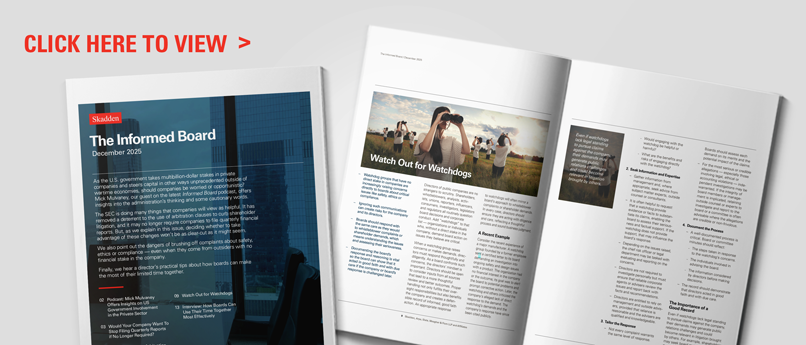
View other articles from this issue of The Informed Board
- Podcast: Mick Mulvaney Offers Insights on US Government Involvement in the Private Sector
- Could Mandatory Arbitration Spell the End of Securities Class Actions?
- Watch Out for the Watchdogs
- Interview: How Boards Can Use Their Time Together Most Effectively
This memorandum is provided by Skadden, Arps, Slate, Meagher & Flom LLP and its affiliates for educational and informational purposes only and is not intended and should not be construed as legal advice. This memorandum is considered advertising under applicable state laws.