
Executive Summary
- What’s new: The SEC has proposed a comprehensive package of amendments that would transform the filer status framework by simplifying the filer status definitions and extending scaled disclosure and other accommodations to a greater number of companies.
- Why it matters: If adopted, the amendments could significantly reduce burdens and compliance costs for newly public companies and companies with a public float below $2 billion.
- What to do next: Companies should determine their filer status under the proposed rules and evaluate any potential necessary changes to their existing disclosure controls and procedures and internal control over financial reporting.
__________
On May 19, 2026, the Securities and Exchange Commission (SEC) proposed amendments that would fundamentally restructure the filer status framework and extend the scaled disclosure and other accommodations currently available to smaller reporting companies (SRCs) and emerging growth companies (EGCs) to a far broader set of companies.
The proposed amendments are part of the SEC’s ongoing initiative to incentivize companies to go and stay public, including by simplifying the regulatory landscape and rightsizing disclosure requirements through the lens of materiality. On the same day, the SEC proposed sweeping changes (discussed in our client alert “SEC Proposes Sweeping ‘Registered Offering Reform’ to Expand Access to Public Capital Markets”) that would dramatically expand the number of companies eligible to use Form S-3 and extend powerful registration and communication accommodations currently reserved for well-known seasoned issuers (WKSIs) to a broader range of issuers.
If adopted, the filer status amendments would rebalance reporting obligations to scale more meaningfully with market capitalization and maturity, which could significantly reduce burdens and compliance costs for a large number of companies.1
Simplification of the Filer Status Framework
Background
Under the current framework, public companies are categorized into five partially overlapping filer/reporting status designations, with varying disclosure requirements and reporting timelines.
Table 1. Current Filer Statuses and Reporting Statuses
| Filer Statuses | Reporting Statuses |
|---|---|
|
Large accelerated filers Accelerated filers Non-accelerated filers |
Smaller reporting companies Emerging growth companies
|
The current framework is layered and complex, requiring companies to annually reevaluate their status(es), taking into account, among other things, their public float as of the last business day of their most recently completed second fiscal quarter and their annual revenue. Notably, and as illustrated below, companies can qualify for multiple filer and reporting statuses simultaneously (e.g., a company can be both an SRC and an accelerated filer).
Table 2. Relationships Between SRCs and Non-Accelerated, Accelerated and Large Accelerated Filers Under the Current Rules
| Status | Public Float | Annual Revenue |
|---|---|---|
| Non-accelerated filer and SRC | Less than $75 million | N/A |
| $75 million to less than $700 million | Less than $100 million | |
| Accelerated filer and SRC | $75 million to less than $250 million | $100 million or more |
| Accelerated filer (not SRC) | $250 million to less than $700 million | $100 million or more |
| Large accelerated filer | $700 million or more | N/A |
The SEC has granted significant accommodations to SRCs and EGCs to reduce burdens and compliance costs related to the initial public offering process and ongoing public company reporting responsibilities. For example, EGCs are exempt from the requirement to obtain an auditor attestation of management’s assessment of the effectiveness of the company’s internal control over financial reporting (ICFR), as well as from the requirements to hold say-on-pay and say-on-frequency advisory votes, and SRCs are permitted to provide two (instead of three) years of audited financial statements in their annual reports and scaled executive compensation disclosure.
Proposed Amendments to the Filer Status Definitions
The proposed amendments would significantly alter the large accelerated filer definition, including by:
- Raising the public float threshold from $700 million to $2 billion.
- Changing the public float calculation window from the closing price on the last business day of the company’s second fiscal quarter to the average closing price over the last 10 trading days of the second fiscal quarter.
- Requiring companies to satisfy (or not satisfy) the public float threshold for two consecutive years before changing filer status.
- Extending the seasoning requirement from 12 calendar months to 60 calendar months.
The proposed amendments also would eliminate the accelerated filer and smaller reporting company categories, such that all companies that are not large accelerated filers are deemed non-accelerated filers.2 This streamlined filer status structure is intended to simplify the regulatory scheme applicable to public companies.
Public float. Under the amended rules, a company would qualify as a large accelerated filer only if the company’s public float was $2 billion or more, calculated based on the company’s average closing stock price over the last 10 trading days of the company’s second quarter. The 10-trading-day calculation window is intended to minimize the risk of a single day’s market volatility resulting in an unexpected change to a company’s filer status.
In addition, the $2 billion public float threshold must be met (or not met) for two consecutive years in order for the company’s filer status to change. This means that, once a company enters or exits a filer status, it would remain in that status for at least two years.
Unlike under the current rules, there would not be separate, lower thresholds for exiting a filer status.
Seasoning. The amended rules would require a company to have been subject to the reporting requirements of the Securities Exchange Act of 1934 (Exchange Act), as amended, for 60 consecutive months to qualify as a large accelerated filer. As a result, newly public companies would be deemed non-accelerated filers for a minimum of five years, regardless of their public float or revenue.
Annual assessment. Consistent with the current rules, companies would be required to assess their filer status annually, as of the last day of their fiscal year.
Table 3. Comparison of Large Accelerated Filer Conditions
| Current | Proposed |
|---|---|
|
|
Proposed Extension of Scaled Disclosure and Other Accommodations
The proposed amendments would extend to all non-accelerated filers the scaled disclosure and other accommodations currently applicable to SRCs and EGCs.3
Given the proposed 60-month seasoning period for large accelerated filers, newly public companies would have a minimum five-year “on-ramp” to take advantage of these accommodations. The SEC believes this five-year period would provide companies ample time to adjust to the SEC’s disclosure and filing requirements and also encourage more companies to go and stay public.
Table 4. Certain Key Accommodations for Non-Accelerated Filers Under the Proposed Rules
| Requirement | During IPO Process | Ongoing Reporting Obligations Post-IPO |
|---|---|---|
| Financial statements |
|
|
| Auditor attestation on ICFR under Section 404(b) of the Sarbanes-Oxley Act |
|
|
| Executive compensation disclosure |
|
|
| Say-on-pay and say-on-frequency advisory votes |
|
|
| Compliance with new or revised GAAP accounting standards applicable to public companies |
|
|
| * For the company’s first five years after initial registration with the SEC. | ||
Table 5. Filing Deadlines for Periodic Reports Under the Proposed Rules
| Form | Large Accelerated Filer | Non-Accelerated Filer | Small Non-Accelerated Filer | |
|---|---|---|---|---|
| Form 10-K |
60 days after fiscal year end | 90 days after fiscal year end | 120 days after fiscal year end | |
| Form 10-Q |
40 days after fiscal quarter end | 45 days after fiscal quarter end | 50 days after fiscal quarter end | |
| Note: The proposed rules would not change existing filing deadlines for Form 8-K. | ||||
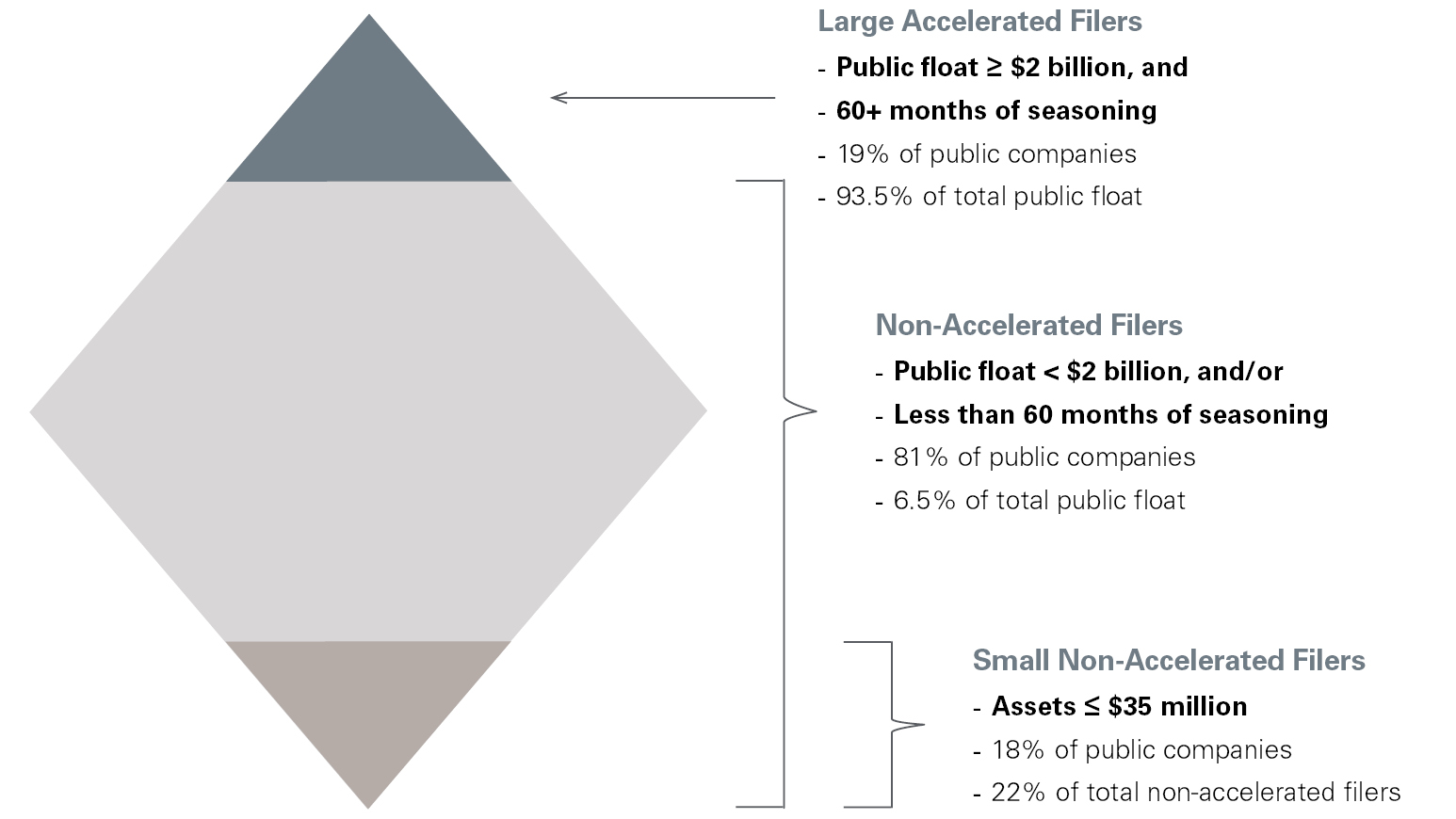
The SEC estimates the proposed amendments would result in 1,721 additional companies (approximately 29% of all public companies) being newly eligible to qualify as non-accelerated filers, meaning approximately 81% of all public companies could use these accommodations.
Proposed New Filer Categories4
Treatment of Foreign Private Issuers
Currently, foreign private issuers (FPIs) are permitted to use specialized forms and rules designated for FPIs. In light of the accommodations already provided to FPIs, FPIs that elect to comply with the rules and forms designated for FPIs (e.g., Form 20-F and Form 40-F) would not be eligible to use the proposed accommodations for non-accelerated filers.
As a result, an FPI that files annual reports on Form 20-F and has a public float of $75 million or more as of the last business day of the company’s most recently completed second fiscal quarter would continue to be required to include in its Form 20-F an auditor attestation of management’s assessment of the effectiveness of the company’s ICFR, unless the FPI qualifies as an EGC.
The proposed amendments would not revise the way an FPI filing on Form 20-F performs the public float determination for purposes of filer status to align with how a registrant using the domestic forms would determine its public float for purposes of the large accelerated filer definition (i.e., based on average of the stock price over the last 10 trading days of the second quarter). As a result, there will be differences between the two public float determinations.
Proposed Transition Period
If adopted, the amendments would require companies to assess their filer status as of the end of their fiscal year prior to the effectiveness of the final rules. Companies would need to conduct that initial assessment no later than the day prior to the last day of their fiscal year in which the final rules go into effect.
|
Illustrative Example If the SEC adopts final rules that become effective on January 15, 2027, then existing calendar-year-end companies would be required to assess their filer status as of December 31, 2026. Those companies would be permitted to complete such assessment as of any date between January 15, 2027, and December 30, 2027. |
Large accelerated filers under the current rules that fail to conduct the initial assessment by that deadline would retain their large accelerated filer status until at least the next assessment date. All other companies that fail to conduct the initial assessment by the deadline would be deemed non-accelerated filers.
A company that conducts the initial assessment and qualifies as a non-accelerated filer could begin utilizing the scaled disclosure and other accommodations in its first Securities Act or Exchange Act filing following the assessment.5
Comment Period
The public comment period will remain open until July 20, 2026. The SEC has requested comments on several aspects of the proposal, including whether the proposed $2 billion public float threshold and 60-calendar month seasoning period for large accelerated filers are appropriate.
Practical Considerations
The proposed amendments, if adopted, would result in a sweeping overhaul of the filer status framework. Current large accelerated filers that would qualify as non-accelerated filers under the proposed rules should assess whether any changes to their existing disclosure controls and procedures and internal control over financial reporting would be necessary if the rules are adopted.
In addition, private companies currently considering accessing the public markets should take note of the proposed five-year “on-ramp” and reassess the potential burdens and compliance costs of going public, and their current IPO timeline, accordingly.
_______________
1 The SEC estimates that 80.8% of current public companies would be non-accelerated filers under the proposed rules. See p. 149 of the Proposing Release.
2 The proposed amendments would also create a new subcategory of non-accelerated filers, known as “small non-accelerated filers,” consisting of non-accelerated filers with total assets of $35 million or less as of the end of their two most recent second fiscal quarters. Small non-accelerated filers would be granted an additional 30 days to file their annual reports on Form 10-K (extending their filing deadline from 90 days to 120 days after fiscal year end) and an additional five days to file their quarterly reports on Form 10-Q (extending their filing deadline from 45 days to 50 days after fiscal quarter end).
3 Note, however, that the proposed amendments would require non-accelerated filers to disclose in their annual reports on Form 10-K or Form 20-F the substance of any material unresolved staff comments received by the company staff regarding its periodic or current reports under the Exchange Act not less than 180 days before the fiscal year end. Currently, this requirement does not apply to non-accelerated filers.
4 Source: Annex A, Fact Sheet − Enhancing the Public Company Reporting Framework
5 Companies that qualify as small non-accelerated filers also could begin using the extended small non-accelerated filer deadlines for Form 10-Qs and Form 10-Ks filed after the assessment.
This memorandum is provided by Skadden, Arps, Slate, Meagher & Flom LLP and its affiliates for educational and informational purposes only and is not intended and should not be construed as legal advice. This memorandum is considered advertising under applicable state laws.