
Editor’s note: A longer version of this article was published as a client alert on July 27, 2026.
Key Points
- Europe’s defense sector is undergoing unprecedented transformation, and competition authorities are recognizing this evolving landscape in their assessments.
- A broader policy lens means that transactions and collaborations may be reviewed more favorably where they support defense readiness and sovereign capability.
- In this environment, successful dealmaking and investments may require an integrated approach across merger control, foreign subsidies, foreign direct investment and national security screening frameworks, as well as approvals under the EU’s state aid rules.
__________
Mounting geopolitical tensions and heightened security concerns have highlighted the need for greater scale, resilience and autonomy in Europe’s defense sector. This need has prompted a fundamental policy shift that is resulting in the European Commission (EC) weighing broader security objectives alongside traditional competition concerns, which could allow for greater corporate collaboration and consolidation.
The evolving regulatory landscape provides both unprecedented opportunities and heightened regulatory challenges for corporate acquirers, private equity and strategic investors in the defense sector. Long-standing conventions among allied investors will not always continue, as Europe looks toward independent resilience.
A Policy Shift Toward Defense Investment and Scale
The European Union introduced a Defence Readiness Omnibus (Omnibus) in June 2025 that signals that the EC will explicitly reflect the evolving security and defense landscape in its competition assessments alongside existing competition rules. The Omnibus follows on the heels of the EU’s Defence Readiness 2030 strategy — launched in March 2025 under the broader ReArm Europe plan — which aims to mobilize up to €800 billion in defense investment by 2030.
The effort to position defense as an engine for economic growth and innovation is also underway in the U.K.
In its June 2026 Defence Investment Plan, the U.K. government pledged a £298 billion investment in defense funding over the next four years. It projected raising NATO-qualifying spending — meaning defense spending that counts toward NATO commitments — to 2.7% of gross domestic product (GDP) by 2027-28 and targeted 3.5% by 2035, a promise new Prime Minister Andy Burnham reiterated on his first day in office. (The timetable for further increases beyond 2.7% remains subject to the U.K. Treasury’s next spending review.)
The Competition and Markets Authority’s (CMA’s) September 2025 Scale-Ups and Competition Policy highlights the defense sector as a key area where competition policy can support the scaling up of innovative firms in the U.K. The CMA and U.K. Ministry of Defence are identifying potentially anticompetitive regulations governing autonomous weapons and technologies.
Merger Control: A New Openness to Consolidation
The Omnibus signals that the EC is willing to consider the broader contribution of a merger to the EU’s defense readiness and strategic autonomy — particularly where mergers enhance the EU’s global competitiveness and resilience.
True to that theme, the EC’s revised draft merger guidelines (Draft Guidelines), issued in April 2026, provide that EU merger control should protect innovation and investment competition in a manner that supports resilience and accelerates industrial capabilities in defense markets.
This equips merging parties with a broader set of arguments to demonstrate that a transaction is procompetitive, including by reference to its contribution to EU defense policy objectives. In practice, transactions that might previously have raised concerns due to high market shares or vertical integration may be assessed more favorably.
The Draft Guidelines also introduce an “innovation shield” — criteria under which the EC will not in principle find competition concerns. These thresholds are likely to be valuable to defense sector acquirers targeting small startups or scale-ups offering unique technologies or patents.
When Does the Innovation Shield Apply?
| Scenario | When the Shield Applies |
|---|---|
| The parties have no competitive relationship in the same or vertically related innovation space. | Neither party is currently active, or expected through its R&D to become active, in the same market or innovation space, or in a vertically or otherwise closely related market/innovation space. |
| One party’s R&D project overlaps with the other party’s existing business. | The parties have no more than 40% market share (individually or combined) and there are at least three independent firms with R&D projects of similar competitive potential. |
| The parties’ R&D projects overlap. | At least three independent firms have R&D projects with similar competitive potential to those of the parties. |
| The parties’ broader R&D capabilities overlap. | The parties’ combined share is no more than 25% in the innovation space and no more than 25% of R&D activities at industry level. |
| An R&D project is vertically/closely related to the other party’s existing business. | The parties have no more than 40% market share (individually or combined) in the relevant vertical or otherwise closely related market. |
The final EC revised guidance is expected by the end of 2026.
The trend toward rapid clearance of defense transactions is already visible at both the EU and national levels. For example, the Leonardo/Iveco transaction — a €1.7 billion acquisition of Iveco’s defense vehicles division — received unconditional merger control clearance from the EC in March 2026. The EC described the decision as another example of it “swiftly approving a transaction that supports the EU’s defense sector without harming competition in Europe.”
The U.K.’s CMA is also shifting its policy. Notably, in September 2026, the authority published revised guidance on merger efficiencies. The guidance expressly recognizes that mergers can enhance firms’ ability or incentive to innovate and invest in research and development (R&D) — including by combining complementary capabilities — and that such dynamic efficiencies may spur rivals to respond, thus strengthening the competitive process.
The CMA’s openness to efficiencies that materialize over longer time frames and regard for industry-specific investment and innovation cycles may provide additional arguments for defense transactions where scale and technological integration are central to the deal rationale.
Foreign Direct Investment: Prioritizing Sovereign Capability and Resilience
Against the background of increasingly unpredictable transatlantic relations, European governments are using foreign direct investments (FDI) to bolster and defend their sovereign capabilities.
Investors from allied countries, including the U.S., are facing higher levels of mitigation in defense and related sectors, such as the U.K. government attaching conditions to Australian Pen10’s acquisition of Amiosec, a cybersecurity business serving government customers.
Where deals are approved, typical security and governance requirements are being supplemented with requirements to maintain supply to domestic defense customers and to keep manufacturing, development and R&D capabilities in-country.
European authorities now also routinely scrutinize U.S. export controls and International Traffic in Arms Regulations (ITAR) exposure created by transactions in an effort to avoid having European technology fall within the net of U.S. trade controls. As seen by the failed talks for the U.K. to participate in the EU’s €150 billion Security Action for Europe (SAFE) funding program, Europe’s hardening of its approach is not limited to the U.S.
Foreign Subsidies Regulation: First Two Defense Transactions Cleared
Beyond merger control and FDI, investors in the defense sector may face scrutiny under the EU’s Foreign Subsidies Regulation (FSR). The FSR is a tool designed to prevent financial support from non-EU governments from giving businesses an unfair advantage when undertaking M&A or bidding for significant public contracts.
However, the vast majority of M&A FSR reviews have been unproblematic since the FSR regime’s inception in mid-2023, and the EC unconditionally cleared the first two defense transactions under the regime in early 2026.
The EC’s FSR guidelines also state that, in complex cases, defense policy considerations may be taken into account to ensure that the regulation does not undermine the EU’s own policy goals or security interests.
Agreements Between Competitors: Encouraging Competitor Cooperation
While anticompetitive agreements and information exchanges among competitors continue to be prohibited, the EC’s Omnibus shows a willingness to provide tailored antitrust guidance for defense-sector cooperation projects that support defense objectives.
Future tailored antitrust guidance could be particularly relevant for collaborations aimed at quickly scaling up production or engaging in joint procurement of raw materials — areas where individual companies may lack the capacity to act alone.
When evaluating such agreements, the EC intends to consider the efficiencies generated, including contributions to defense readiness and supply chain resilience. Such guidance would have the potential to create greater legal certainty for companies seeking to pursue joint projects that address critical defense needs.
In the U.K., the CMA released guidance in August 2025 aimed at helping businesses understand how to collaborate without breaching competition law. The CMA may also develop sector-specific guidelines to facilitate cooperation among market participants in the defense ecosystem.
Despite the recognition of sector-specific needs, competition authorities remain willing to take enforcement action against anticompetitive conduct, with steep penalties — fines of up to 10% of global turnover and debarment from participation in public procurement procedures for up to five years.
The CMA is now in talks with the U.K. Ministry of Defence about obtaining procurement data to reduce the risk of companies colluding to win public contracts — a key risk area in defense contracting — using an in-house tool to scan tender information for suspicious patterns.
State Aid: Expanding the Scope for Government Investment
Significant public funding is being made available for the defense sector, accompanied by adjustments to the regulatory framework governing such support. Key EU funding tools include:
- The Important Projects of Common European Interest (IPCEI) framework, which supports large-scale, cross-border initiatives.
- The Strategic Technologies for Europe Platform (STEP), which channels investment into critical technologies.
- The European Defence Fund, which co-finances collaborative defense R&D.
According to European Defence Agency data released on July 16, 2026, EU governments are expected to spend an overall 2.4% of GDP on defense in 2026, reaching €454 billion — a 9% year-over-year increase.
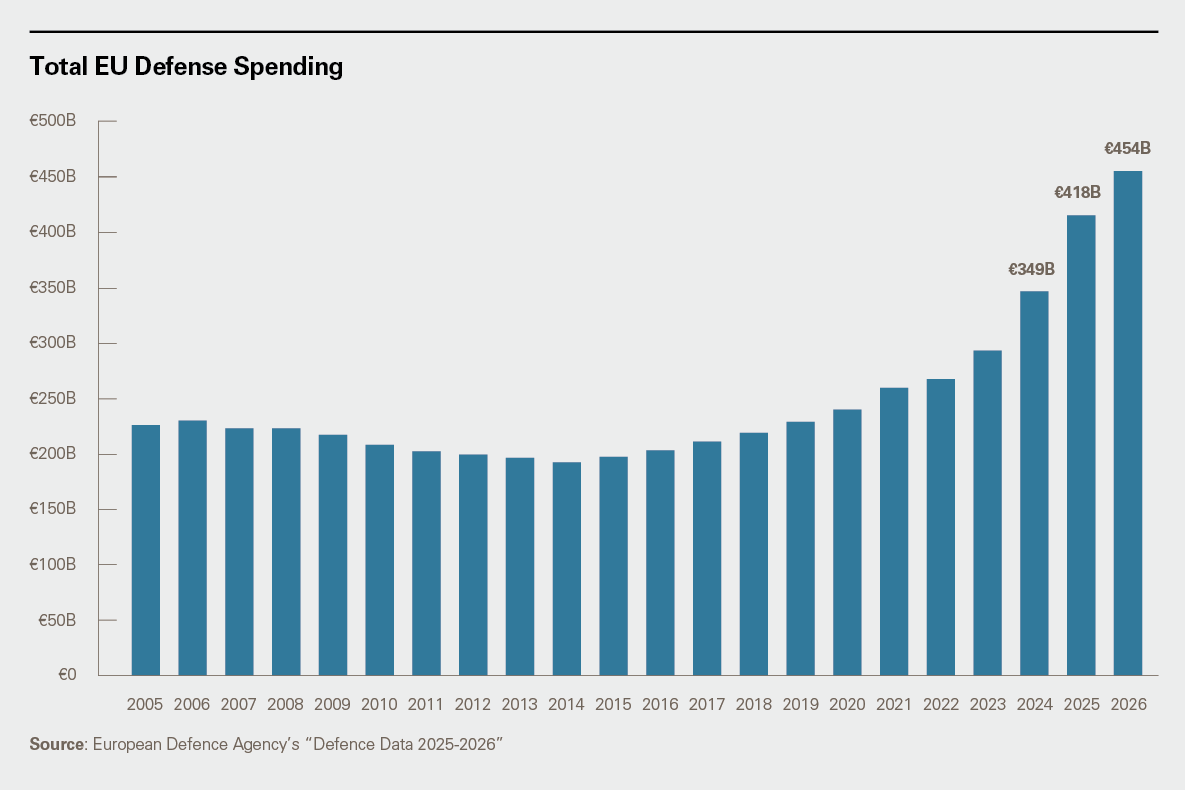
Funding mechanisms to support defense and critical technologies may need to be notified to, and approved by, the EC under state aid rules, which prevent member states from conferring unfair financial advantages to specific companies so as to ensure a level playing field across the single market.
The Omnibus seeks to support the rapid scale-up of defense production with the help of exemptions or relaxations in state aid rules. Notably, government funding of projects that can demonstrate they are essential to national security interests — including support for military infrastructure — may benefit from exemptions or receive administrative priority in the approval process.
State aid cases linked to defense readiness that are not exempt will still receive administrative priority, reflecting the urgency of strengthening the EU’s defense capabilities.
In practice, this means that noneconomic support — including for military infrastructure, core military functions and defense production capabilities — may not require EC notification.
Additional adjustments to the rules may be forthcoming. In its October 2025 Defence Readiness Roadmap, the EC indicated that it may “modernise its approach under State aid rules in the sector and possibly provide guidance,” including for potential sector-specific exemptions or streamlined procedures for defense-related projects.
Looking Ahead
Competition authorities across Europe are recalibrating their frameworks to give greater weight to defense readiness, supply chain resilience and innovation. This policy shift presents an opportunity for companies and investors to pursue strategic transactions, investments and collaborations that support EU and U.K. defense objectives. But they must remain vigilant about compliance requirements and the evolving regulatory environment.
Early and integrated regulatory planning across the merger control, FSR, FDI and state aid frameworks remains essential.
Senior knowledge strategy lawyer Elizabeth Malik contributed to this article.
Related Reading
This memorandum is provided by Skadden, Arps, Slate, Meagher & Flom LLP and its affiliates for educational and informational purposes only and is not intended and should not be construed as legal advice. This memorandum is considered advertising under applicable state laws.