
Executive Summary
- What’s new: Lloyd’s of London has completed an extensive review and consolidation of its Byelaws and other rules, creating a “single, modern and user-friendly” guidebook to organise these requirements.
- Why it matters: This initiative improves accessibility and transparency for Lloyd’s market participants, making it easier for individuals and firms to navigate and comply with the rules governing the Lloyd’s market.
- What to do next: Market participants should familiarise themselves with the new consolidated framework.
__________
On 15 December 2025, Lloyd’s of London1 (Lloyd’s) announced that it had completed an extensive review of the Lloyd’s Byelaws and other rules and created a consolidated version of these requirements, which is available on the Lloyd’s website. The laudable goal of this exercise is to organise these requirements into a “single, modern and user-friendly” guidebook.
Our view is that this is a very useful initiative from the Lloyd’s Secretariat. Lloyd’s had a busy 2025, with a series of new entrants and capital providers participating at Lloyd’s. This initiative complements this growth story by making the Byelaws and other rules governing the Lloyd’s market more accessible and transparent. Additionally, Lloyd’s has taken the opportunity to publish Omnibus Amendment Byelaw (No. 1 of 2025), which consolidates a number of administrative amendments to certain Byelaws. Consolidating these amendments in one byelaw is another helpful development that will assist with accessibility to, and the transparency of, the Lloyd’s market.
In this publication, we will:
- Recap the background to how Lloyd’s is regulated and the basis of the Byelaws and other rules.
- Discuss the impact of Lloyd’s consolidation exercise.
- Consider what’s next as Lloyd’s continues to make the Byelaws and other rules more accessible.
How Is Governance at Lloyd’s Structured?
In the UK, the Prudential Regulation Authority (PRA) effectively regulates Lloyd’s as if it were a single (re)insurer. Pursuant to the PRA Rulebook, the Lloyd’s market is considered a single “Solvency II firm” which subsumes the members.2 However, Lloyd’s does not itself undertake insurance business, and is not authorised to do so, but provides and regulates (through its governing body — the Council of Lloyd’s) a marketplace in which each member undertakes insurance business for its own account, with a central backstop. As a result, Lloyd’s itself has a comprehensive, layered governance and regulatory framework that can be broken down as follows:
- Byelaws: Quasi-constitutional rules with legal force made by the Council of Lloyd’s under powers granted by UK Acts of Parliament, notably the Lloyd’s Act 1982, that are binding on all Lloyd’s participants and enforceable through sanctions.
- Rules: Issued by Lloyd’s under the authority granted by the Byelaws focusing on day-to-day regulation of the Lloyd’s market and applicable to members of the Lloyd’s market and other Lloyd’s market participants to which a particular Rule relates.
- Guidance: Sets out how Lloyd’s expects members and other Lloyd’s market participants to comply with the Byelaws and other rules mostly on a “comply or explain” principle basis.
- Bulletins: Formal communications from Lloyd’s often setting out new Byelaws and other rules, clarifying Lloyd’s expectations or announcing deadlines or transitional arrangements.
In general terms, the Lloyd’s Acts establish the Lloyd’s market, Byelaws govern its constitution, Rules regulate behaviour, and Guidance explains how Lloyd’s expects those Byelaws and other rules to be satisfied.
What’s Changed?
Previously, no consolidated framework comprising Byelaws and other rules existed. Increasingly as the Lloyd’s market developed, Lloyd’s market participants seeking clarity on particular topics would be required to navigate multiple Byelaws in order to ensure that they were considering all relevant requirements. This new consolidated version brings together Byelaws and other rules into a single location, organised thematically throughout the lifecycle of Lloyd’s:
- Starting at Lloyd’s: The requirements governing individuals and firms starting to participate in the Lloyd’s market.
- Operating at Lloyd’s: Requirements relating to general, ongoing operation in the Lloyd’s market, covering core activities, compliance and operational matters.
- Exiting Lloyd’s: Requirements regarding exiting the Lloyd’s market.
Set out in the Annex to this article is a structural diagram that shows the contents of the consolidated version. For example, if searching for guidance on admission to membership, the “Starting at Lloyd’s” page will signpost requirements for prospective members, underwriters, intermediaries and annual subscribers. On the “Becoming a Member” page, prospective members can then see all requirements specific to them and can easily navigate to the “Admission to Membership” page which sets out the relevant Lloyd’s requirements (whether Byelaws or other rules) which are relevant to that particular topic.
There are two important caveats to bear in mind when using this consolidated version of Byelaws and other rules. Firstly, it does not (yet) contain links to, or relevant requirements and guidance contained in, Guidance and Bulletins. Secondly, Lloyd’s makes clear on the landing page that this consolidated version may not yet be complete and that they anticipate making further updates. Regardless, this initiative is a welcome development and provides for a framework for further amendments to further improve accessibility to Byelaws and other rules.
What’s Next?
This consolidation of Byelaws and other rules is an excellent example of an initiative that addresses a key challenge faced by Lloyd’s market participants in a way that provides immediate results while providing the necessarily flexible framework for further improvements to address the future needs of Lloyd’s market participants. It is yet another example of how the Lloyd’s marketplace is successfully evolving to increase its attractiveness to new participants.
We expect that this consolidated version will be further built out to increase its comprehensiveness, including with references to applicable Guidance and other requirements.
Senior paralegal Tyron Kerns contributed to this article.
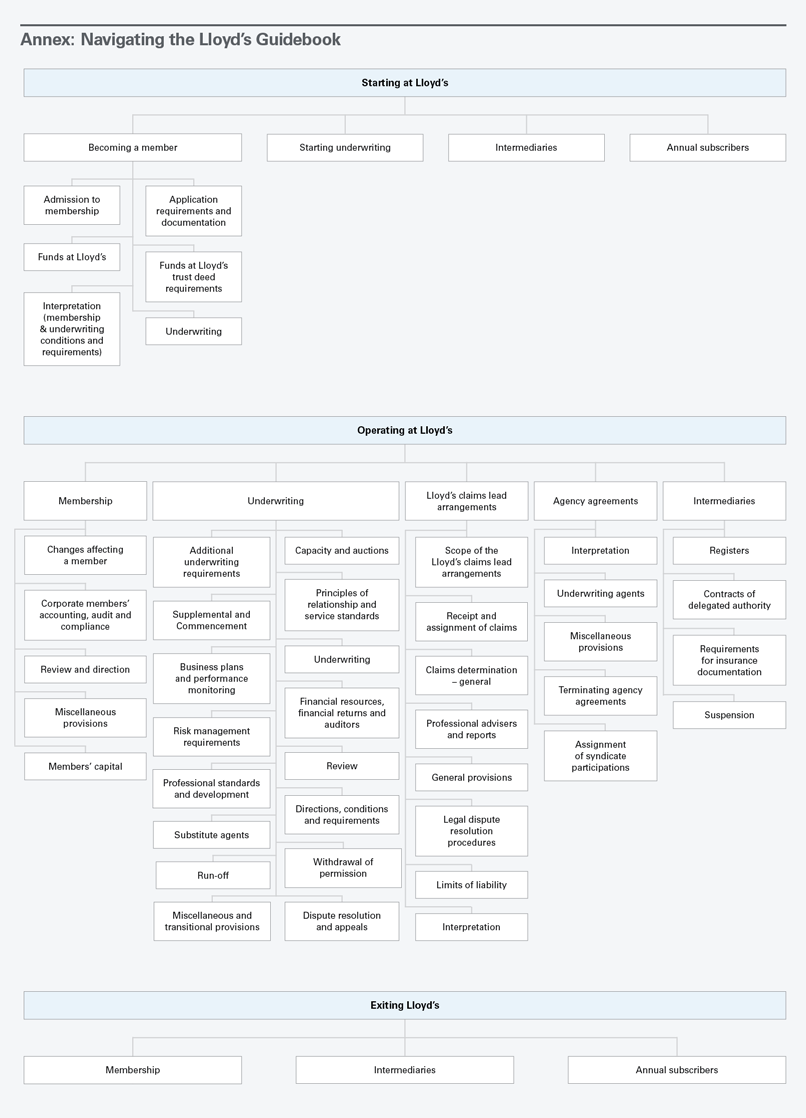
See an interactive version of this diagram.
_______________
1 Lloyd’s of London is the trading name for Lloyd’s, which is a statutory corporation incorporated by a private Act of Parliament in 1871. It is also referred to in more recent financial services legislation as the Society of Lloyd’s.
2 Pursuant to the PRA Rulebook, the majority of rules under Solvency II apply to Solvency II firms, with certain modifications made for Lloyd’s. In general, individual Lloyd’s managing agents are treated as non-financial / non-regulated entities.
This memorandum is provided by Skadden, Arps, Slate, Meagher & Flom LLP and its affiliates for educational and informational purposes only and is not intended and should not be construed as legal advice. This memorandum is considered advertising under applicable state laws.