
A recent Delaware ruling is drawing attention for emphasizing the high bar that stockholders must clear when alleging a board acted in bad faith. Bad faith means a conscious dereliction of duty, so a stockholder has to plead fairly extreme facts to withstand a motion to dismiss.
The August 13, 2026, Court of Chancery decision in In re Boeing reinforces with clarity long-standing Delaware law protecting boards from second-guessing by plaintiffs based on adverse events rather than fiduciary wrongdoing. It is particularly significant at a time when other states have attempted to persuade companies to reincorporate away from Delaware, arguing that Delaware is not sufficiently director-friendly.
Also significant: The case was decided by Delaware Supreme Court Justice Morgan Zurn, sitting as a Vice Chancellor on the Court of Chancery, where she served before she was recently elevated to the state’s high court.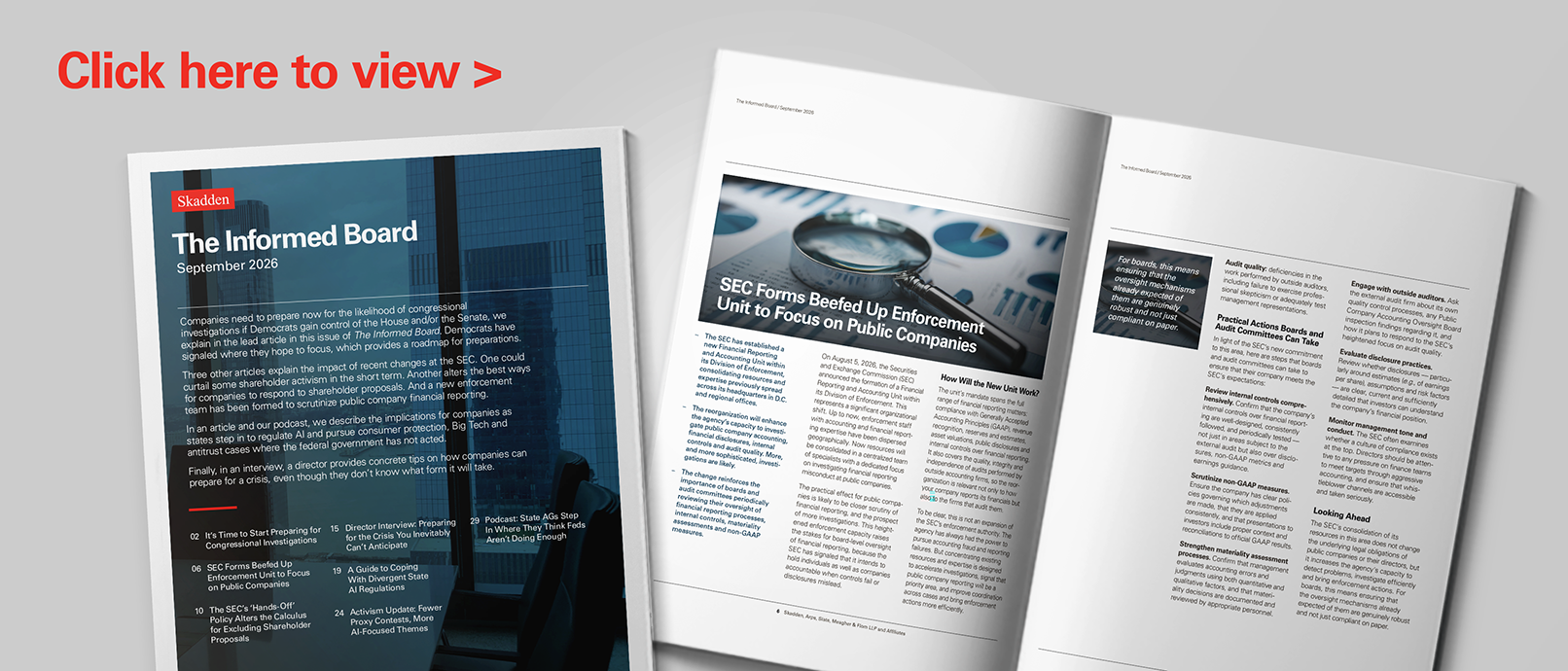
The Boeing case involved stockholder failure-of-oversight (so-called Caremark) claims arising from a 2024 incident where a jet’s door plug blew off at 15,000 feet due to poor manufacturing. The plaintiffs alleged that the aerospace company’s board acted in bad faith and breached its duties by not adequately overseeing the company’s safety and quality control programs.
Noting that the board had created an Aerospace Safety Committee and a Product and Services Safety Organization that reported to that committee and the company’s chief engineer, the court stated, “the stockholders themselves tell a story of a board that was attentive to safety” and “received copious reporting on numerous manufacturing and compliance risks, as well as management’s ongoing efforts to reduce those risks.” Justice Zurn said, “Delaware law does not hold corporate fiduciaries liable merely because a generalized risk materialized.”
This case comes on the heels of other recent opinions and judicial remarks emphasizing the continued vitality of Delaware’s business judgment rule, the essence of which is that Delaware courts won’t second-guess board decisions. These rulings continue a long line of Delaware cases holding that an allegation of bad faith in oversight must go far beyond nit-picking board actions, and that, even if in hindsight a board made a mistake or a bad decision, that does not by itself constitute bad faith.
The bottom line: Delaware law continues to presume that boards act diligently and in good faith. To survive a motion to dismiss in an action alleging bad faith oversight claims against directors, stockholder plaintiffs therefore face a daunting high hurdle to plead a conscious dereliction of duty in Delaware.
View other articles from this issue of The Informed Board
- It’s Time to Start Preparing for Congressional Investigations
- SEC Forms Beefed Up Enforcement Unit to Focus on Public Companies
- The SEC’s ‘Hands-Off’ Policy Alters the Calculus for Excluding Shareholder Proposals
- Director Interview: Preparing for the Crisis You Inevitably Can’t Anticipate
- A Guide to Coping With Divergent State AI Regulations
- Activism Update: Fewer Proxy Contests, More AI-Focused Themes
- Podcast: State AGs Step In Where They Think Feds Aren’t Doing Enough
See all the editions of The Informed Board
This memorandum is provided by Skadden, Arps, Slate, Meagher & Flom LLP and its affiliates for educational and informational purposes only and is not intended and should not be construed as legal advice. This memorandum is considered advertising under applicable state laws.