
Key Points
- Almost 60% of U.S. activist campaigns were directed at technology and consumer/retail companies. Complaints about the pace of artificial intelligence adoption figured in many tech campaigns.
- Only four proxy contests went to a vote, but activists still obtained 51 board seats, mainly through negotiated settlements.
- Many campaigns continue to be launched outside traditional nomination windows.
- New SEC guidance requiring disclosure of investors in entities used to target specific companies may impact activist activity in near term.
- Continued regulatory scrutiny of proxy advisory firms and efforts to curb voting blocs at large institutional investors may make shareholder votes harder to predict.
__________
H1 Set Another Record in the U.S.
The first half of 2026 provided no respite for boards from activist demands, as this was the busiest first half on record for shareholder activism in the U.S. According to FactSet data, there were 71 new campaigns at U.S.-incorporated companies, narrowly surpassing last year’s first half and well above the five-year average over the same period.1
Micro- and small-cap companies remain the most common targets, but no company is immune. While companies valued below $2 billion accounted for 62% of U.S. campaigns in H1 2026, mid-caps ($2 billion to $10 billion) accounted for 25% of all U.S. campaigns, and large- and mega-cap companies still accounted for roughly one in eight campaigns.
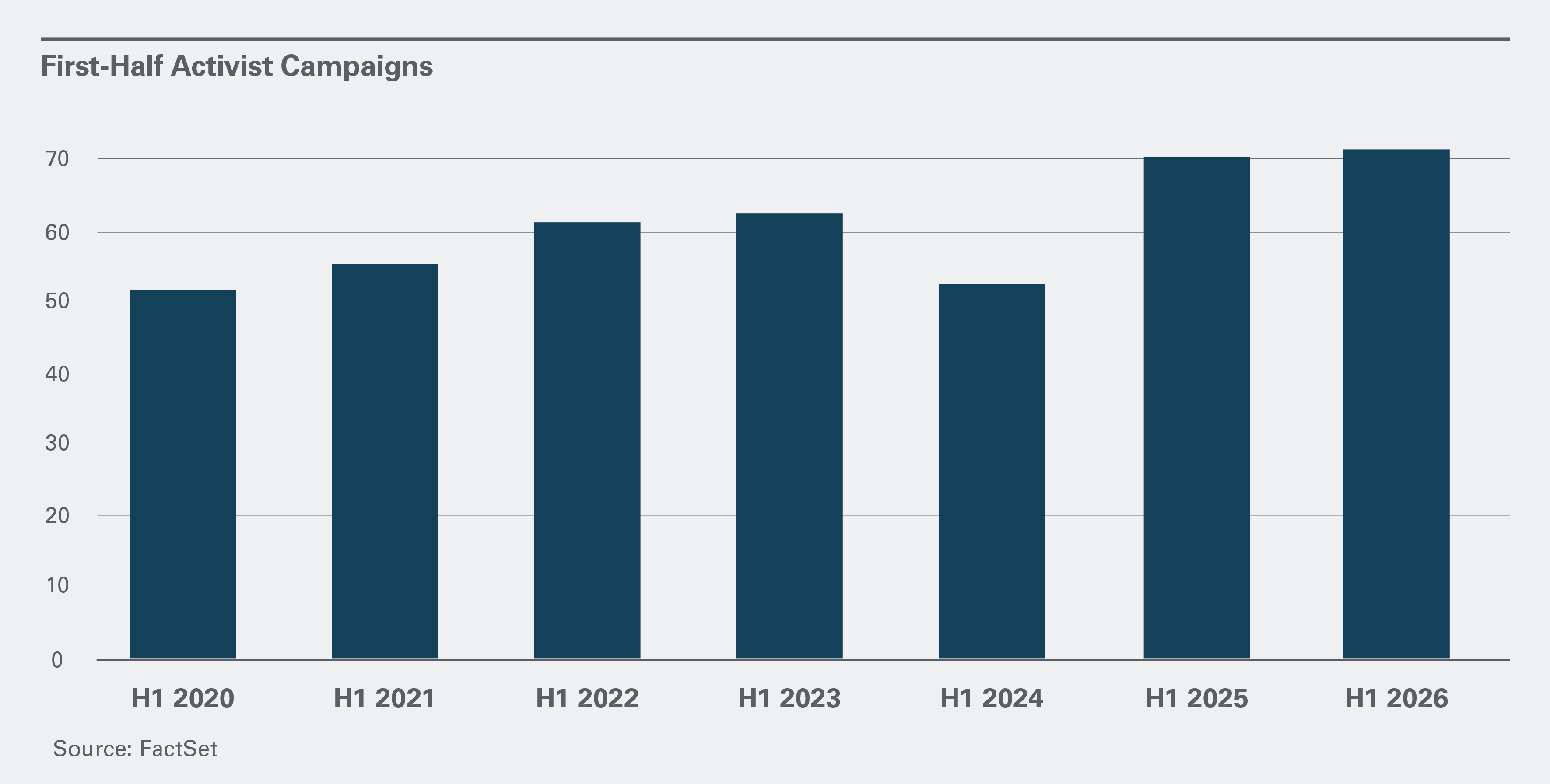
First-Half Activist Campaigns
Technology and Consumer/Retail Sectors Were Most Targeted, Many with AI-Focused Campaign Themes
Technology was the most targeted sector by a wide margin during H1 2026, accounting for nearly two-fifths of U.S. campaigns, with consumer/retail second at just over a fifth. Together, the two sectors accounted for close to 60% of all U.S. activism campaigns.
While most campaigns remain focused on M&A, capital allocation and portfolio optimization, nearly 30% of U.S. technology campaigns in H1 2026 featured an AI angle, and the theme appeared in roughly one in six U.S. campaigns overall.
Most often activists claimed that a company is not moving fast enough to leverage or capture the benefits of AI, such as using AI to unlock cost savings, improve productivity and accelerate growth. At other times, activists argue that a company is not sufficiently communicating its AI-related efforts to investors and the market at large.
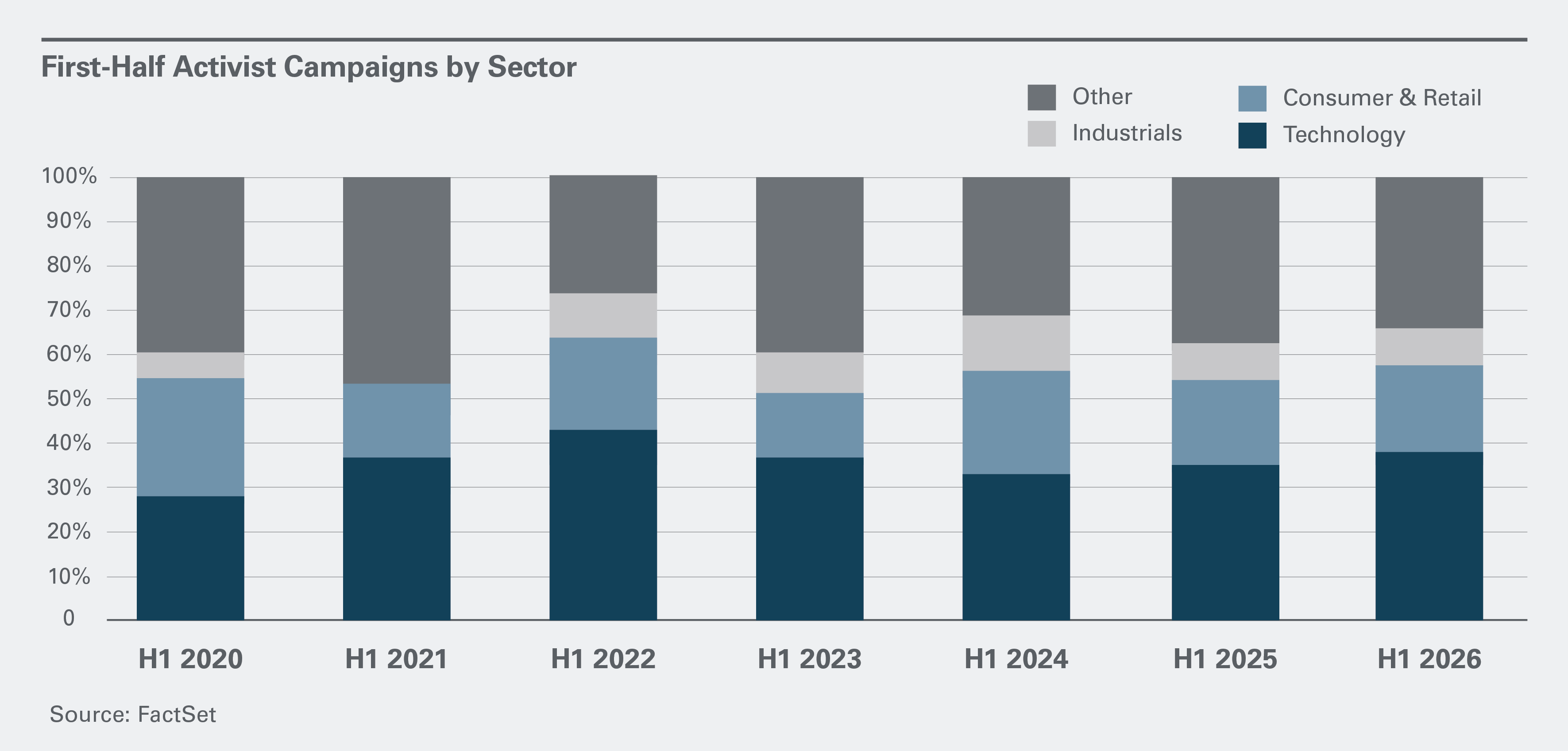
First-Half Activist Campaigns by Sector
H1 2026 Saw Few Proxy Fights; Most Board Seats Were Won Without a Vote
The number of U.S. contests that went to a shareholder vote in H1 2026 declined sharply from prior years, and nearly all board seats were obtained by activists without a vote. Just four U.S. campaigns reached a vote in H1 2026, less than half the prior-year figure, and activists won just a single seat in those four contests. Still, activists secured some 50 board seats, mostly through negotiated settlements.
Activists also obtained other concessions from boards through informal settlements, typically relating to business reviews, share repurchase programs or leadership changes. As we discussed in an April 2026 article, “Should Boards Be Wary of Informal Settlements With Shareholder Activists?” these can provide a cost-effective resolution for both sides, but the downside is that the company does not gain contractual protections.
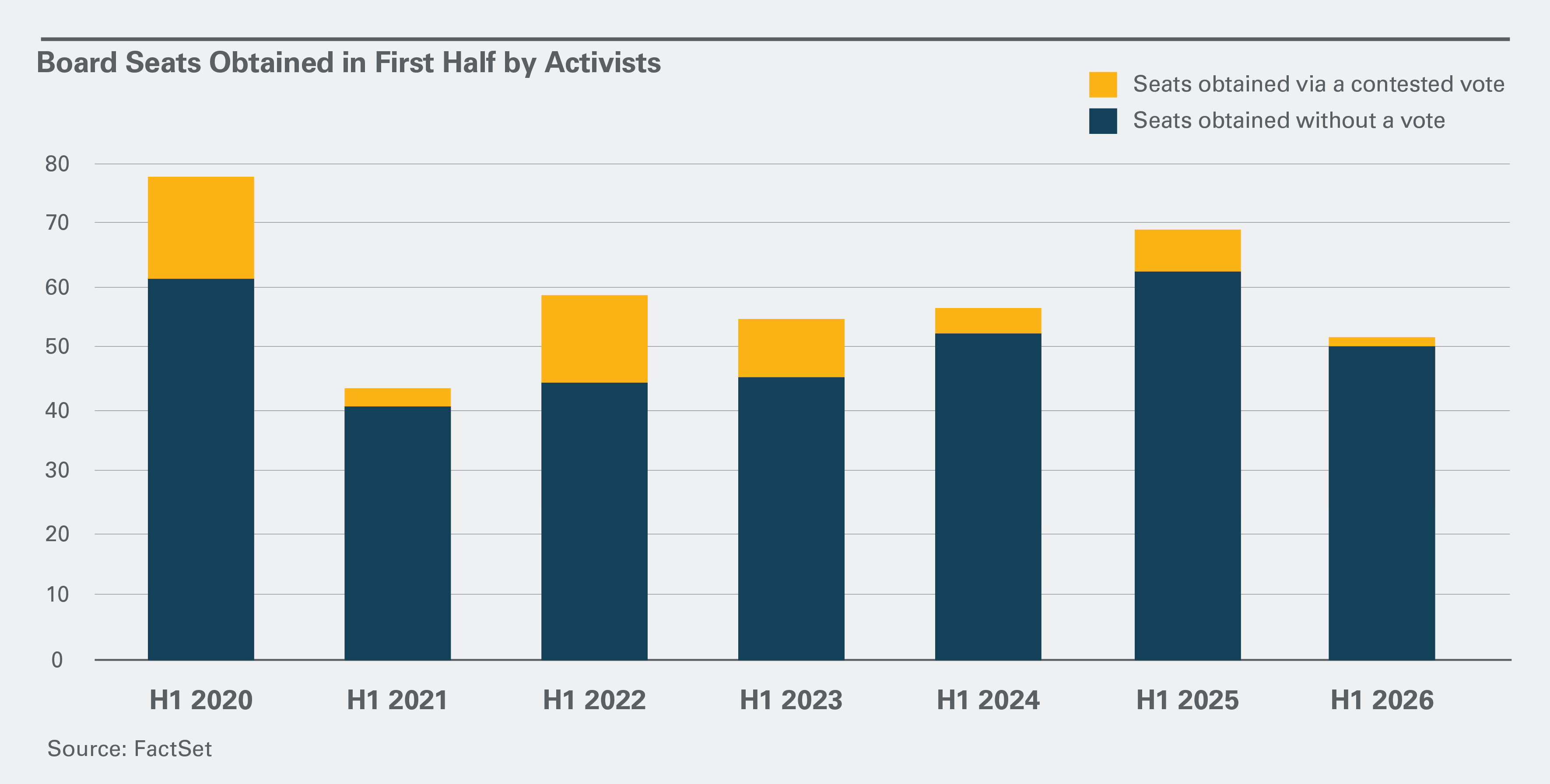
Pressure Campaigns Outside Proxy Season Are Proving Effective
Activists are increasingly launching off-cycle pressure campaigns, leveraging sophisticated multimedia and digital strategies, that are no longer tied to traditional annual meeting timelines.
Activists can often obtain commitments from boards that wish to avoid extended public pressure campaigns that can disrupt a company’s business operations, instead of launching full proxy election contests.
New SEC Guidance on SPVs Could Impact Activist Activity in the Near Term
On July 9, 2026, the Securities and Exchange Commission (SEC) staff issued interpretive guidance that could materially constrain the ability of certain activists to raise funds to launch activist campaigns.
Based on the new guidance, where a special purpose vehicle (SPV) is formed to acquire securities of a specific company and run an activist campaign there, and investors in the SPV are told in advance of both that purpose and the target’s identity, the staff now takes the view that the identity of the investors must be disclosed in any Schedule 13D (reporting more than 5% ownership) the SPV must file with the SEC.
Similarly, where the SPV is formed to finance a proxy solicitation to change the board’s composition and investors receive the same advance notice, each investor contributing more than $500 is treated as a “participant” in the solicitation, and information about them must also appear in any proxy statement filed by the activist with respect to the target.
This new guidance is likely to impact smaller and mid-sized activist funds that rely heavily on SPVs to build outsized positions separate and apart from their core diversified investment funds. Since many investors who back these vehicles demand anonymity, they may decline future investment opportunities if there is any risk that they might be identified in a public filing, potentially causing a temporary downshift in activity by these smaller activist funds.
Pressure on Proxy Advisory Firms, AI-Guided Voting and Other Factors May Make Outcomes Less Predictable
The proxy advisory landscape is fragmenting as proxy advisory firms have increasingly come under attack by regulators. A December 2025 executive order directed the SEC to review and consider revising or rescinding proxy advisor rules and guidance to assess whether proxy advisory firms should register as investment advisers, and to have the staff examine whether investment advisers that follow proxy advisor recommendations on non-pecuniary factors are acting inconsistently with their fiduciary duties.
In addition, in August 2026, the U.S. Department of Justice’s Antitrust Division withdrew a 1987 business review letter that protected proxy advisory firm Institutional Shareholder Services (ISS) from antitrust enforcement, citing antitrust concerns about ISS’ and Glass Lewis’ potential to shape corporate governance policies.
Amid this unfriendly regulatory climate, Glass Lewis has announced that it will eliminate its standard benchmark voting recommendations in 2027, moving to recommendations built on client-specific investment philosophies.
Three other factors could also contribute to making votes less predictable:
- The “Big Three” institutional investors have split their stewardship divisions, raising the prospect of split votes within one institution.
- They have also expanded their pass-through voting programs allowing their underlying investors to direct voting decisions instead of the firms’ stewardship teams.
- JPMorgan and Wells Fargo announced they were cutting ties with their proxy advisory firms, preferring instead to make voting decisions with the aid of AI tools.
As a result of this potential unpredictability, boards may need to expand their shareholder communications to reach a larger audience, engage earlier and more precisely with significant shareholders and tailor communications to investors’ differing priorities. See our February 2026 Informed Board article, “Will Curbs on Proxy Advisors Make Shareholder Votes Less Predictable?”
______________
1 FactSet, data as of July 31, 2026. The dataset is limited to companies with a market capitalization greater than $100 million and excludes: (i) exempt solicitations; (ii) campaigns targeting funds registered under the Investment Company Act of 1940; (iii) ESG- and compensation-focused campaigns; (iv) short-seller activism; (v) campaigns limited to supporting or opposing management or stockholder proposals; (vi) hostile M&A; (vii) instances in which a Schedule 13D was filed but no activism was publicly disclosed; and (viii) labor unions, public pension funds and religious groups as the activist.
View other articles from this issue of The Informed Board
- It’s Time to Start Preparing for Congressional Investigations
- SEC Forms Beefed Up Enforcement Unit to Focus on Public Companies
- The SEC’s ‘Hands-Off’ Policy Alters the Calculus for Excluding Shareholder Proposals
- Director Interview: Preparing for the Crisis You Inevitably Can’t Anticipate
- A Guide to Coping With Divergent State AI Regulations
- Podcast: State AGs Step In Where They Think Feds Aren’t Doing Enough
- Delaware Court Reaffirms Deference to Directors in Risk Management Cases
See all the editions of The Informed Board
This memorandum is provided by Skadden, Arps, Slate, Meagher & Flom LLP and its affiliates for educational and informational purposes only and is not intended and should not be construed as legal advice. This memorandum is considered advertising under applicable state laws.