
Key Points
- The Gulf Cooperation Council’s traditionally oil-based economies are growing as they diversify.
- Sovereign wealth funds and state-owned enterprises are the key vehicles through which diversification is being realized.
- On the horizon, we expect continued investment in sectors that support the diversification agenda and will underpin the future economies of the GCC member states — notably artificial intelligence, renewable energy and financial services.
__________
In the first half of 2025, the Middle East’s M&A deal volumes grew by 19% — a significant growth relative to global M&A — according to analysis by professional services provider PwC.
Driving this growth are the region’s sovereign wealth funds (SWFs) and state-owned enterprises (SOEs), which are putting into practice the policy of economic diversification adopted by the six member states of the Gulf Cooperation Council (GCC): Bahrain, Kuwait, Oman, Qatar, Saudi Arabia and the United Arab Emirates (UAE).
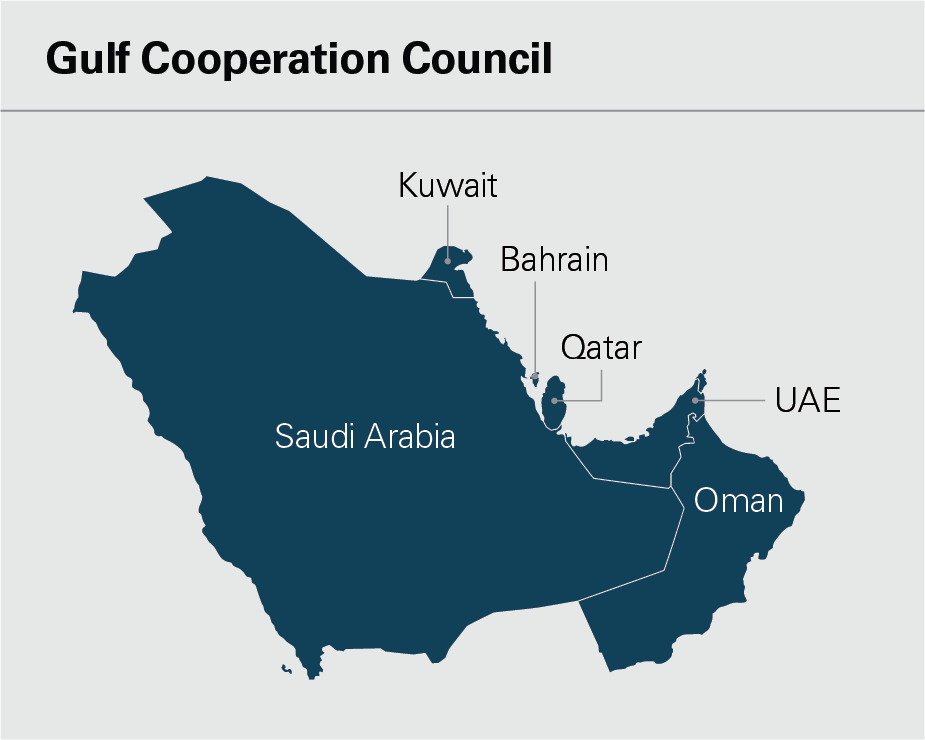
While three of the GCC states are among the top five oil producers in the world, in recent years their non-oil exports have grown exponentially. Abu Dhabi’s non-oil economy already accounts for 56.2% of its 2025 gross domestic product (GDP), and the non-oil exports of the GCC are expected to reach $1 trillion by 2030, according to Strategy&, a PwC strategy consulting business.
Recent M&A activity shows that this transformation is being strategically implemented by the SWFs and SOEs of the GCC’s member states, which are transitioning from being primarily co-investment partners and limited partner investors to more actively deploying substantial capital and leading investments toward sectors that will shape their future economies.
Artificial Intelligence and Digital Infrastructure
The GCC is laying the groundwork for its participation in the AI revolution, positioning itself as a global hub for AI innovation and digital transformation. This is exemplified by the GCC’s partnerships with global players to secure inbound investment into AI-enabling digital infrastructure. (See “Structured Finance Is Playing a Key Role as the Capital Demands of Data Center and Power Build-Outs Balloon.”)
Recent examples include:
- Blackstone’s partnership with Humain, a Saudi Arabian AI company, to invest roughly $3 billion into the construction of data centers in the country.
- OpenAI’s partnership with G42, an AI firm backed by Mubadala Investment Company (MIC), to develop a 5-gigawatt data center cluster in Abu Dhabi.
Outbound, GCC investors are taking stakes in the world’s leading AI and data infrastructure companies. Examples include:
- Qatar Investment Authority’s (QIA) participation in Anthropic’s Series F $13 billion fundraise.
- Abu Dhabi Investment Authority’s (ADIA) $1.6 billion investment in Vantage Data Centers’ Asia Pacific hyperscale data center platform.
Another landmark deal in 2025 was the $40 billion acquisition of Aligned Data Centers by MIC-backed MGX, alongside BlackRock’s Global Infrastructure Partners (GIP) and AI Infrastructure Partners (a joint venture in which MGX and GIP are also invested, as well as global players such as Nvidia and Microsoft). Kuwait Investment Authority is also a financial investor in AI Infrastructure Partners.
By investing with global tech leaders, GCC investors can amplify their access to cutting edge opportunities and help steer the trajectory of innovation. These strategic partnerships not only elevate the GCC’s global technology profile but also help secure access to AI capabilities that will underpin future economic productivity.
According to PwC, by 2030 AI is expected to account for 12.4% of Saudi Arabia’s GDP and 14% of the UAE’s GDP.
Transitional Energy
As AI infrastructure scales, renewable energy investments are becoming critical to power data centers sustainably. Domestically, each GCC member state is pursuing policy targets in relation to the proportion of its power that will be derived from renewable sources.
The most ambitious of these policy targets is Saudi Arabia’s aim to receive 50% of its electricity from renewable sources by 2030. In pursuit of this goal, the GCC has entered into partnerships for the development and financing of renewable energy projects in the region, with the Middle East on track to receive over $75.6 billion in renewable energy projects by 2030, according to a September 2024 report by the trade association Energy Industries Council.
Renewable Energy Targets – GCC Member States
|
Bahrain |
Kuwait |
Oman |
Qatar |
Saudi Arabia |
UAE |
|
|---|---|---|---|---|---|---|
|
Net Zero Target |
2060 |
2060 |
2050 |
None |
2060 |
2050 |
|
Renewables Target |
5% by 2025 10% by 2035 |
15% by 2030 |
30% by 2030 |
18% by 2030 |
50% by 2030 |
32% by 2030 (incl. nuclear) |
Source: Observer Research Foundation Middle East
The GCC states have also set ambitious targets for outbound investments, to further diversify their economies in relation to transitional energy.
Abu Dhabi Future Energy Company (Masdar) is planning a global renewable energy portfolio of 100 gigawatts by 2030. It participated in landmark transactions in the past year, including its:
- $3.5 billion take-private of Greece’s Terna Energy, one of the largest-ever European Union renewables transactions.
- $6.1 billion acquisition, alongside Iberdrola, of the U.K.’s largest offshore wind project.
Meanwhile, in recent years Abu Dhabi has also launched:
- XRG, the international lower-carbon energy and chemicals investment arm of Abu Dhabi National Oil Company (ADNOC), in 2025.
- Altérra, a climate investment fund that is deploying the UAE’s initial $30 billion commitment to catalyze up to $250 billion for sustainable investments by 2030.
The GCC’s energy transition and AI agendas are deeply intertwined. The energy-intensive nature of data centers and AI infrastructure means that investments in clean energy are not just about sustainability, they are also a strategic enabler of the region’s digital ambitions.
Financial Services
Another long-standing focus for the GCC is the financial services sector as it seeks to attract foreign direct investment from the world’s largest financial institutions and position the region as a global financial hub connecting the East and the West.
The UAE in particular has made big strides in this regard, with a 72% increase in the number of hedge funds registered in the Dubai International Finance Centre between July 2024 and July 2025. The Abu Dhabi Global Market (ADGM) financial center has also seen 26% growth in registered financial services firms in the first quarter of 2025.
Notable new entrants to the ADGM include the U.K. challenger bank Revolut and Reinsurance Intelligence Quotient, an AI-driven reinsurance platform developed through a partnership worth $1 billion involving BlackRock, Lunate and International Holding Company.
Outbound investments by GCC investors into financial institutions also continued to build momentum in 2025:
- In August 2025, Mubadala Capital completed its $8.7 billion take-private of CI Financial, a Canadian wealth management and asset management advisory firm, having also agreed to enter into a $10 billion investment alliance with TWG Global, an American investment holding company.
- In a landmark transaction that bolsters both inbound and outbound investment in the UAE, the Abu Dhabi-based investment firm Lunate agreed to acquire a minority stake in the U.S. hedge fund Brevan Howard and commit a significant amount of long-term capital to a new investment platform in the ADGM.
What We’re Watching
As the GCC accelerates its diversification journey, M&A activity in AI, energy transition and financial services will continue to define the region’s economic footprint.
Its shift from investing passively to leading significant investments in technology, sustainable energy and financial innovation is not only transforming domestic economies but also positioning the Middle East as a pivotal force in global capital markets.
Read more about M&A and capital markets:
- M&A in the AI Era: What Buyers Can Do to Confirm and Protect Value
- The Long-Anticipated Wave of Bank Consolidation Starts to Break
- ‘Premiumization’ and Slow Organic Growth Are Likely to Feed Food and Beverage M&A
- Boards Face Continued Pressure to Pursue Spin-Offs as Investors Seek Corporate Clarity and Value Creation
- Liability Divestiture Transactions: A Win-Win for Financial Buyers and Mass Tort Defendants
- Political Law Due Diligence in M&A Transactions Is Increasingly Critical
- Strategic Capital Meets Innovation: How Government and Industry Are Shaping the Next Wave of Market Growth
- Key Considerations for Private Equity Sponsors Aiming to Take Portfolio Companies Public
- Hong Kong Exchange Speeds Up Listing Reviews and Loosens Retail Allocation
See the full 2026 Insights publication
This memorandum is provided by Skadden, Arps, Slate, Meagher & Flom LLP and its affiliates for educational and informational purposes only and is not intended and should not be construed as legal advice. This memorandum is considered advertising under applicable state laws.